


Best Fat Tyre Electric Bikes: 8 Models Compared 2026
Fat tyres make an e-bike look ready for almost anything. But the real reason to buy one has less to do with looks and more to do with where you ride.
Those wide tyres give you a larger contact patch with the ground. That can make the bike feel more planted on gravel, loose paths, sand and uneven roads. They also add some cushioning, which is useful when your route is less than perfect.
There is a trade-off, though. A fat tyre electric bike is usually heavier and bulkier than a conventional e-bike. The wider tyres create more rolling resistance too, so they aren’t automatically the best choice for everyone.
For this guide, we compared eight fat tyre electric bikes available to UK buyers. Rather than looking only at battery size and claimed range, we considered the things that actually change how useful each bike is: tyre size, motor, battery, suspension, portability, equipment and the type of riding each model suits.
Quick Comparison
| Model | Tyres | Motor / torque | Weight | Battery | Claimed range | Suspension | Best for |
| VARUN M26-2 Plus | 26 x 4.0in | 250W, 80Nm | 39kg | 48V 18Ah (864Wh) | Up to 95 miles | Front + seat | Best overall |
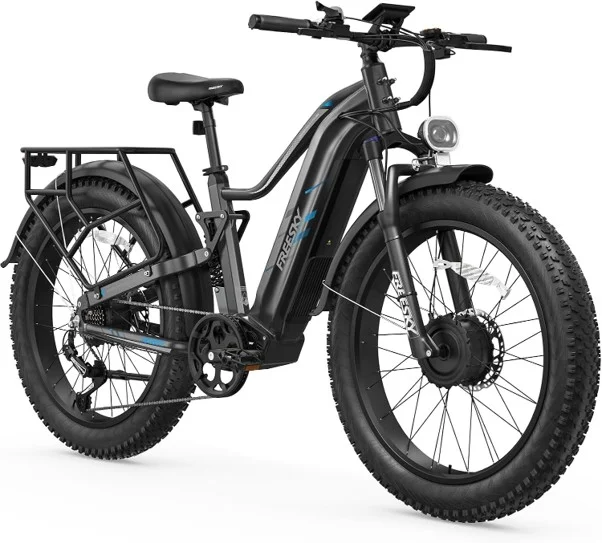
| FREESKY Wildcat Ultra | 26 x 4.0in | 250W road mode* | 34.9kg | 48V 25Ah (1,200Wh) | Up to 105 miles | Full | Long rides |
| SPATIAL Spa26p2 | 26 x 4.0in | 250W, 80Nm | 30.5kg | 48V 13Ah (624Wh) | Up to 65 miles | Front | Value 26-inch |
| FLYRUN F2013 | 20 x 4.0in | 250W, 75Nm | 32.1kg | 48V 13Ah (624Wh) | Up to 75 miles | Front | Everyday utility |
| URLIFE T5 | 20 x 4.0in | 80Nm torque sensor | 36kg | 48V 13Ah | 50-62 miles | Full | Folding |
| Aairsk X5 | 20 x 4.0in | 250W | 35kg | 48V 15Ah | Up to 50 miles | Not clearly stated | Budget mixed terrain |
| URLIFE T16 | 16 x 3.0in | 250W | 33kg | 48V 13Ah (624Wh) | Up to 62 miles* | Dual | Compact riding |
| FREESKY Eurostar Turbo | 26 x 4.0in | 250W road config.* | 45kg | 48V 25Ah | Up to 105 miles* | Full | Demanding terrain |
*Manufacturer/Amazon listing claim. Actual range will depend heavily on assistance level, rider weight, hills, weather, tyre pressure and riding conditions.
8 Best Fat Tyre Electric Bikes in the UK
1. VARUN M26-2 Plus – Best Overall

The VARUN M26-2 Plus is the bike I’d start with if you want the advantages of fat tyres without moving into a much more expensive model.
Its biggest strength is the combination of a 48V 18Ah battery and a 250W motor producing a claimed 80Nm of torque. VARUN gives the battery a maximum range figure of around 95 miles, although you shouldn’t expect that on every ride. Hills, cold weather and higher assistance settings will bring it down.
Key specifications
| Motor | 250W brushless hub motor, claimed 80Nm torque |
| Battery | 48V 18Ah removable battery (864Wh) |
| Claimed range | Up to 150km / around 95 miles |
| Tyres | 26 x 4.0in fat tyres |
| Suspension | Front suspension plus seat shock absorption |
| Brakes | Front and rear disc brakes |
| Drivetrain | 7-speed |
| Weight | 39kg |
| Equipment | Rear rack, headlight, taillight, LCD display |
The 26 × 4.0in tyres are where this bike separates itself from a conventional commuter. You have more rubber underneath you on gravel, muddy tracks and loose surfaces, while the front suspension and seat shock absorption provide another layer of cushioning. The supplied specification also includes front and rear disc brakes.
I also like that VARUN hasn’t forgotten everyday practicality. You get a rear rack, mudguards, lights, seven-speed gearing and a removable battery. That makes it easier to use as a fat tyre electric bike for commuting rather than something you only take out at weekends.
The downside is size. A full-sized 26-inch electric fat bike isn’t what I’d choose if you live upstairs or have very limited storage.
Best for: riders who want one fat tyre e-bike for commuting, leisure rides and light off-road use.
Pros
- Large 864Wh removable battery
- 80Nm claimed motor torque
- 26 × 4.0in tyres
- Rear rack included
- Seven-speed gearing
Cons
- Large frame takes up more storage space
- Less portable than a 20-inch model
- Mechanical rather than hydraulic disc brakes
2. FREESKY Wildcat Ultra – Best for Long Rides

If battery capacity matters more than keeping the price or weight down, the Wildcat Ultra moves things in a different direction.
Its 48V 25Ah Samsung battery works out at 1,200Wh, which is almost twice the capacity of some bikes in this comparison. FREESKY claims up to 170km, or roughly 105 miles, under suitable conditions. It also pairs the large battery with a 3A charger.
Key specifications
| Battery | 48V 25Ah Samsung battery (1,200Wh) |
| Claimed range | Up to 170km / around 105 miles |
| Tyres | 26in fat tyres |
| Suspension | Full suspension |
| Drivetrain | 7-speed |
| Equipment | LCD, NFC/password/key unlocking, USB-C, 800-lumen headlight, turn signals and brake light |
| Warranty | 24 months motor/battery/controller; 12 months other parts |
| Weight | 34.9kg |
You also get full suspension and 26-inch fat tyres. That combination makes more sense if your rides regularly take you over broken roads, tracks and rougher surfaces where a rigid commuter can become tiring.
The step-through frame is another useful touch. It makes getting on and off easier, particularly when you’re making frequent stops.
But there is no escaping the obvious compromise. A 1,200Wh battery, full suspension and 26-inch fat tyres don’t make for a small bike. If your idea of portability involves carrying an e-bike upstairs every evening, this isn’t the model I’d pick.
If range is your main priority, you can also see how two long-distance options compare in our FREESKY Dual Battery vs Fafrees FF20 Polar Pro guide.
Best for: longer rides where battery capacity, comfort and rough-surface capability matter more than portability.
Pros
- Huge 1,200Wh Samsung battery
- Full suspension
- Step-through frame
- 26-inch fat tyres
- Integrated lights and turn signals
Cons
- Expensive compared with simpler models
- Large and bulky
- More bike than many short-distance commuters actually need
3. SPATIAL Spa26p2 – Best Value 26-Inch Option

The SPATIAL is interesting because its headline motor figures aren’t far away from the VARUN’s.
You get a 250W continuous-rated brushless motor with a claimed 80Nm of torque, five pedal-assist levels and a seven-speed drivetrain. Its removable 48V 13Ah battery stores 624Wh and carries a claimed assisted range of up to 104km, or roughly 65 miles.
It also uses 26 × 4.0in tyres with front suspension. For mixed road and gravel riding, that’s a sensible combination. The tyres provide the extra footprint you are probably looking for from a fat tyre ebike, while the suspension takes some of the sharpness out of potholes and rough tracks.
Key specifications
| Motor | 250W continuous-rated brushless motor, claimed 80Nm |
| Battery | 48V 13Ah removable battery (624Wh) |
| Claimed range | Up to 104km / around 65 miles |
| Tyres | 26 x 4.0in |
| Suspension | Front fork |
| Brakes | Mechanical disc |
| Drivetrain | 7-speed |
| Assist | 5 pedal-assist levels |
| Weight | 30.5kg |
The braking system is more ordinary. You get mechanical discs rather than hydraulic brakes. That’s not necessarily a deal-breaker, but it’s one area where I’d prefer to see an upgrade on a relatively heavy fat bike.
Best for: buyers who want a straightforward 26-inch fat tyre bike without paying for a huge battery or full-suspension setup.
Pros
- 80Nm claimed torque
- 624Wh removable battery
- 26 × 4.0in tyres
- Five assistance levels
- Seven-speed gearing
Cons
- Mechanical disc brakes
- Non-folding frame
- Less convenient if storage space is tight
4. FLYRUN F2013 – Best for Everyday Utility

Not everyone shopping for a fat tyre bike wants to spend their weekends on muddy trails.
The FLYRUN F2013 is much more interesting as an everyday utility bike. It has a step-through frame, front basket, and rear rack, so carrying shopping or a work bag doesn’t require adding equipment right away.
Key specifications
| Motor | 250W, listing claims 75Nm |
| Battery | 48V 13Ah removable battery (624Wh) |
| Claimed range | Up to 120km / around 75 miles |
| Tyres | 20 x 4.0in |
| Suspension | Front suspension |
| Brakes | Dual disc |
| Drivetrain | 7-speed |
| Equipment | Front basket, rear rack, NFC lock, app dashboard, lights and mudguards |
| Weight | 32.1kg |
The rear rack is rated for up to 50kg according to the supplied listing, while the bike uses a 250W motor, 624Wh removable battery, seven-speed drivetrain and 20 × 4.0in fat tyres. FLYRUN claims up to 120km of assisted range.
Those 20-inch wheels also keep the overall package more manageable than the 26-inch bikes above. You still get the cushioning and grip of 4-inch tyres, but in a format that feels more appropriate for town use.
NFC unlocking and app connectivity are nice extras, but I wouldn’t buy the bike because of them. The basket, rack, step-through frame, and removable battery are the features you’ll probably use most often.
Best for: shopping, commuting and riders who want a practical 20 inch fat tyre electric bike.
Pros
- Front basket and heavy-duty rear rack
- Step-through frame
- 624Wh removable battery
- 20 × 4.0in tyres
- NFC and app connectivity
Cons
- Front suspension only
- Still bulkier than a normal city e-bike
- Claimed 120km range is likely to vary considerably in real use
5. URLIFE T5 – Best Fat Tyre Folding Electric Bike

A folding mechanism normally suggests portability. With the URLIFE T5, I’d think of it more as a storage feature. If portability matters more than off-road ability, you may also want to compare some of the best folding electric bikes before deciding.
That’s because the bike weighs 36kg. Folding it down to approximately 40 × 21 × 30 inches makes it much easier to fit into a garage, hallway or larger car boot, but 36kg is not something most people will want to carry around regularly.
That distinction creates a difference.
Key specifications
| Battery | 48V 13Ah removable |
| Claimed range | 80-100km / around 50-62 miles in pedal assist |
| Tyres | 20 x 4.0in |
| Sensor | Torque sensor, listing claims 80Nm |
| Suspension | Dual / full suspension |
| Brakes | Mechanical disc |
| Drivetrain | 7-speed |
| Weight | 36kg |
| Folded size | 40 x 21 x 30in / approx. 102 x 53 x 76cm |
If you want a fat tyre folding electric bike because your home is short on floor space, the T5 makes sense. If you want one because you’re planning to carry it through stations and up flights of stairs, I’d look elsewhere.
The bike uses 20 × 4.0in tyres, full suspension, mechanical disc brakes and a 48V 13Ah removable battery. URLIFE claims 80–100km in pedal-assist mode under its stated test conditions. The listing also specifies an 80Nm torque sensor system, which should make the assistance respond more naturally to your pedalling effort.
Best for: buyers who need a fat tyre bike that folds for storage rather than frequent carrying.
Pros
- Folding frame
- Full suspension
- 20 × 4.0in tyres
- Removable battery
- Torque-sensing assistance
Cons
- Very heavy at 36kg
- Mechanical disc brakes
- Folding does not make it genuinely lightweight or easy to carry
6. Aairsk X5 – Best Budget Option for Mixed Terrain

The Aairsk X5 sits somewhere between an urban fat bike and a compact fat tyre electric mountain bike
Its 20 × 4.0in tyres give you the width needed for gravel and uneven surfaces without making the bike as physically large as the 26-inch models. The 250W motor is paired with a 48V 15Ah removable battery, with the listing claiming up to 80km, or roughly 50 miles, of range.
That makes the X5 more appealing if you want something for a mixture of roads, park paths and weekend riding rather than one very specific job.
Key specifications
| Motor | 250W |
| Battery | 48V 15Ah removable |
| Claimed range | Up to 80km / around 50 miles |
| Tyres | 20 x 4.0in |
| Speed in listing | 25km/h |
| Equipment | Cycling bag included in listing |
| Weight | 35kg |
The main reason I wouldn’t place it above the VARUN or SPATIAL is that there is less here to separate it from the competition. The 15Ah battery is useful, but I’d want to look carefully at the braking, suspension and overall weight before choosing it purely on its headline range.
Best for: casual mixed-terrain riding and buyers who prefer 20-inch wheels to a full-sized 26-inch bike.
Pros
- 48V 15Ah removable battery
- 20 × 4.0in tyres
- 250W motor
- More compact than a 26-inch fat bike
Cons
- Less comprehensive specification than some rivals
- Not the obvious choice if you primarily ride smooth roads
7. URLIFE T16 – Best Compact Fat Tyre Bike

The T16 is quite different from the other bikes here.
Instead of 20- or 26-inch wheels with 4-inch tyres, it uses 16 × 3.0in tyres. That makes it the most compact-looking option in this comparison and better suited to shorter urban journeys where a full-size fat tyre electric bike for adults may feel unnecessarily cumbersome.
It still gets a 250W brushless motor and 48V 13Ah removable battery. There is front and rear suspension, mechanical disc braking, front and rear lights and an IP54 rating stated in the supplied product information.
Those smaller wheels change the character of the bike, though. I wouldn’t choose the T16 as my first fat tyre ebike for off-road riding. Its strengths are easier handling, compact dimensions and comfort over rough urban surfaces rather than serious trail use.
Key specifications
| Motor | 250W brushless |
| Battery | 48V 13Ah removable (624Wh) |
| Claimed range | Up to 100km / around 62 miles in listing title |
| Tyres | 16 x 3.0in |
| Suspension | Front fork plus rear dual suspension |
| Brakes | Mechanical disc |
| Water resistance | IP54 stated |
| Equipment | Lights, mudguards, colour LCD and lockable storage box |
| Weight | 33kg |
One other point worth noticing is the fixed seat height stated in the listing. Check that carefully against your own height before buying.
Best for: shorter journeys and riders who want the benefits of wider tyres without a large 20- or 26-inch bike.
Pros
- Compact 16-inch wheels
- 624Wh removable battery
- Dual suspension
- Front and rear lights
- IP54 rating stated
Cons
- 3-inch rather than 4-inch tyres
- Fixed seat height may not suit everyone
- Not my first choice for rough off-road riding
8. FREESKY Eurostar Turbo – Best for More Demanding Terrain

The Eurostar Turbo sits at the more serious end of this group.
Its combination of 26-inch fat tyres, full suspension and a large 48V 25Ah battery makes more sense for long rides and rougher terrain than short runs to the shops.
That also means you need to think carefully about whether you actually need what you’re paying for. Large batteries and full-suspension frames add weight and complexity. If most of your riding is a five-mile commute on tarmac, something like the FLYRUN may be easier to live with.
Key specifications
| Battery | 48V 25Ah removable |
| Claimed range | 60-105 miles in seller listing |
| Tyres | 26 x 4.0in |
| Suspension | Full suspension with hydraulic front fork and rear shock |
| Brakes | Seller describes dual 4-piston hydraulic discs with 180mm rotors |
| Drivetrain | 7-speed |
| Equipment | Colour LCD, NFC keyless start, 800-lumen headlight, turn signals, horn, USB-C |
| Warranty | 24 months core components; 12 months other parts |
| Weight | 45kg |
For riders who regularly leave smooth roads behind, however, the larger tyres and suspension give the Eurostar a clear purpose.
Best for: longer mixed-surface rides where comfort and traction are more important than low weight.
Pros
- Large 25Ah battery
- 26-inch fat tyres
- Full suspension
- Built around mixed-terrain use
Cons
- Heavy, bulky design
- Overkill for short urban commutes
- Less convenient to store or transport
Are Fat Tyres Actually Better?
Sometimes but but not always. A conventional e-bike tyre is usually the better choice if most of your riding happens on smooth roads and you care about keeping the bike light and efficient. Fat tyres become more useful when the surface gets worse.
1. Better traction
The wider contact patch can give you more confidence on loose gravel, sand, muddy tracks and other surfaces where a narrower tyre may feel less planted.
That doesn’t turn every fat bike into a mountain bike, though. Tyres are only one part of the equation. Brakes, suspension, frame geometry and the rider still matter.
2. More cushioning
A large-volume tyre can absorb some of the smaller bumps before they reach the frame.
Add front or full suspension and the difference becomes more noticeable on poor roads and tracks. That’s one reason models such as the Wildcat Ultra and URLIFE T5 prioritise both fat tyres and suspension.
3. More weight and rolling resistance
This is the part that gets overlooked. Fat tyres are bigger and heavier. They can also create more rolling resistance, particularly on smooth tarmac. If your battery runs out, pedalling a heavy electric fat bike without assistance isn’t likely to be the highlight of your journey.
They also take up more space. A 26 × 4.0in bike isn’t ideal if you live in a small flat or regularly carry your bike upstairs.
How to Pick the Right one For You
Start with where you actually ride
If most of your riding is on city streets, don’t buy the most extreme bike simply because it has the biggest tyres and battery.
For commuting and shopping, equipment such as mudguards, racks, lights and a removable battery may be more useful. The FLYRUN is a good example.
For gravel, trails and rougher routes, I’d pay more attention to 26-inch tyres, suspension and braking. If your regular route includes steep climbs, our guide to the best e-bike motors and batteries for steep hills explains what matters beyond the basic 250W figure.
Look beyond the claimed range
A 100-mile range figure looks great on a product page, but battery capacity tells you more about what you’re buying.
The Wildcat Ultra’s 1,200Wh battery is genuinely much larger than a 624Wh battery. That doesn’t mean it will travel exactly twice as far. Rider weight, temperature, hills, tyre pressure and assistance level all change the result.
Treat advertised range as a comparison point, not a promise.
Don’t confuse folding with lightweight
The URLIFE T5 demonstrates this perfectly. It folds, but it also weighs 36kg.
That’s useful if you’re trying to fit it into a smaller storage area. It’s much less useful if your daily routine involves carrying it to a third-floor flat.
Consider 20-inch versus 26-inch wheels
A 20 inch fat tyre electric bike gives you a more compact package while retaining wide tyres. That’s useful around town and for storage.
A 26-inch bike generally feels more like a conventional full-sized bicycle and is better suited to riders prioritising stability and longer mixed-terrain journeys. Neither is automatically better. They solve different problems.
Are Fat Tyre Electric Bikes Good for Commuting?
They can be, particularly if your commute includes poor roads, gravel paths or routes where the additional cushioning and traction are useful. There are downsides.
A fat tyre electric bike for commuting will normally be heavier and bulkier than a standard commuter e-bike. If you need to carry it onto a train, lift it upstairs or squeeze it into a small office, that extra size can become annoying quite quickly.
If your commute is entirely smooth tarmac and you already have secure ground-floor storage, you may not gain much from 4-inch tyres. But if your route mixes roads, towpaths, gravel and rough surfaces, a fat tyre setup starts to make much more sense.
Check UK E-Bike Rules Before Buying
Don’t assume a bike is legal for public-road use simply because it is sold through Amazon UK or the listing describes it as “UK legal.”
For an electrically assisted pedal cycle (EAPC), the key UK requirements include pedals that can propel the bike, a maximum continuous rated motor output of 250W and electrical assistance that cuts off at 15.5mph.
This is particularly important with fat tyre bikes because some models are sold in different configurations or include modes intended for private land.
Check the exact UK specification you are buying rather than relying on a model name alone.
FAQs
What is the best fat tyre electric bike?
It depends on how you plan to use it. From these eight models, the VARUN M26-2 Plus offers a particularly useful balance of a large 864Wh battery, 80Nm claimed torque, 26 × 4.0in tyres and everyday equipment such as a rear rack.
For longer rides, the much larger 1,200Wh battery on the FREESKY Wildcat Ultra is more interesting.
Are fat tyre e-bikes harder to pedal?
Usually, yes. Wider tyres tend to have more rolling resistance, and fat tyre e-bikes themselves are often heavy.
The motor largely hides that difference while assistance is running, but you’ll notice it more if the battery runs flat.
Are fat tyre electric bikes good off-road?
They can work well on gravel, sand, loose tracks and rough surfaces because the wider tyres provide a larger contact patch.
For more demanding trails, however, look beyond tyre width. Suspension, brakes, wheel size and frame design matter too.
Is a 20-inch or 26-inch fat tyre e-bike better?
A 20-inch model is generally easier to store and manoeuvre. A 26-inch model gives you the feel and proportions of a full-sized bicycle and can make more sense for longer mixed-terrain rides.
Your storage space and riding environment should decide this one.
Are folding fat tyre e-bikes portable?
Not necessarily.
A folding frame reduces the amount of space the bike occupies, but fat tyres, batteries and suspension can still make the bike very heavy. The URLIFE T5, for example, folds but weighs 36kg.
Are fat tyre electric bikes suitable for UK roads?
They can be, provided the exact bike meets the UK’s EAPC requirements.
Always check the continuous motor rating, assistance cut-off and exact UK configuration before buying.
Conclusion
The best fat tyre electric bike for you comes down to where the extra grip and cushioning will actually be useful.
If I wanted one bike for a mixture of commuting, weekend rides and rougher paths, I’d start with the VARUN M26-2 Plus. Its 864Wh battery, 80Nm claimed torque and 26 × 4.0in tyres give it a useful balance without pushing into the much more expensive end of the category.
If long rides matter more, the FREESKY Wildcat Ultra stands out for its much larger 1,200Wh Samsung battery and full suspension. If your riding is mainly around town, I’d go in the other direction. The FLYRUN’s step-through frame, basket and rear rack make it more practical for commuting and shopping.
The URLIFE T5 is worth considering when storage is the problem, but don’t mistake folding for lightweight. At 36kg, it’s a bike I’d fold to put in a garage or car rather than one I’d want to carry upstairs every day.
