


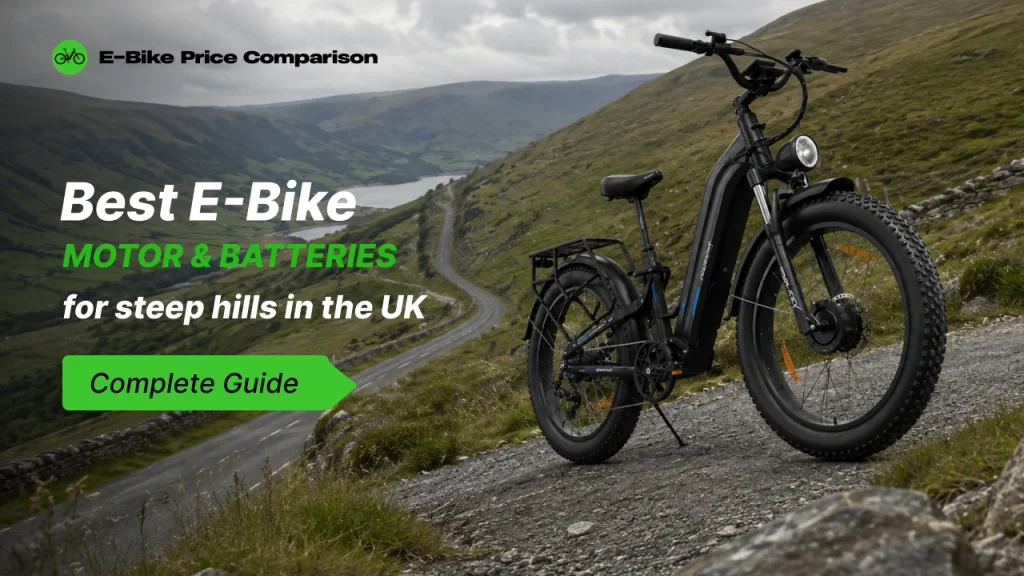
Climbing steep hills in places like the Peak District or Cornwall can instantly destroy an e-bike’s battery if you’re riding the wrong setup. It looks great in the shop, but the moment you hit a steep climb, the motor struggles, the battery drains fast, and you end up putting in more pedal effort than expected.
The most common mistake buyers make is judging a bike by its wattage. A “1000W powerful motor” sounds impressive, but the number that actually determines hill-climbing ability is torque (Nm), not wattage. In this guide, we’ll break down why motor type, torque, voltage, and battery setup matter for hills, what’s legally allowed in the UK, and which bikes suit which type of rider.
Hub motor vs mid-drive motor : the real difference on hills
How a hub motor works
A hub motor sits inside the wheel hub, either the front or rear wheel and drives that wheel directly, independent of the bike’s gearing. That means the motor delivers power the same way regardless of which gear you’re in.
Pros: Cheaper, low maintenance, works well on flat roads and gentle inclines.
Cons on hills: Because it can’t take advantage of the bike’s gearing, a hub motor has to work harder in a single “gear” on steep climbs, which can cause overheating and reduced efficiency on long or steep gradients.
How a mid-drive motor works
A mid-drive motor is mounted at the bike’s centre, integrated with the pedal crank. It uses the bike’s own chain and gears, just like a rider shifting into a lower gear to make pedalling easier on a hill. The motor follows the same principle, optimising torque output as you shift gears.
Pros: More efficient on hills, a more natural pedalling feel, and better weight distribution (since the motor sits centrally), which also improves handling on steep or technical terrain.
Cons: Typically more expensive, and puts extra wear on the chain and gears (since motor force passes through them too).
Bottom line for hills: a mid-drive motor will almost always outperform a hub motor on longer or steeper climbs.
Torque (Nm) — the number that actually matters
Torque measures the motor’s rotational force, how much “twisting power” it can apply. The higher the torque, the easier the bike climbs a steep gradient without the rider having to push harder.
Rough guide for UK terrain:
- 20–40Nm — fine for flat roads and gentle inclines (city commuting)
- 60–80Nm — good for moderate hills and rolling countryside
- 80–100Nm+ — ideal for steep UK hills (15%+ gradient), especially with a heavier rider or cargo load
Important: Two bikes with the same wattage (e.g. both 250W) can still have very different torque outputs, always check the torque figure, not just the wattage.
Wattage vs torque — don’t confuse the two
This is the most common point of confusion for new buyers:
- Wattage measures sustained power output, related to top speed and endurance
- Torque measures the force the motor can apply at a given moment, related to acceleration and hill-climbing
Think of it like cars: a high-horsepower car is great for highway speed, while a high-torque truck can haul a heavy load uphill. The same principle applies to e-bike motors.
Battery capacity (Wh) explained
Battery capacity is measured in watt-hours (Wh), calculated as:
Voltage (V) × Amp-hours (Ah) = Watt-hours (Wh)
The higher the Wh, the more energy the battery can store, meaning longer range. Climbing hills consumes more energy than flat riding (since the motor is working against gravity), so a higher Wh battery is important to avoid a drastic range drop on hilly routes.
Voltage — 36V vs 48V systems
- 36V systems — entry-level, fine for light commuting, but draw more current on steep hills, reducing efficiency
- 48V systems — deliver more consistent torque on climbs, and provide more power at the same current draw, which is why most serious hill-climbing e-bikes use 48V
Recommendation for hills: a 48V system, especially when paired with a mid-drive motor.
Real-world range: hills vs flat roads
An important reality manufacturers rarely highlight, the advertised range (e.g. “60km range”) is almost always based on flat terrain, ideal wind conditions, and average rider weight.
On hilly terrain:
- The motor works in high-power mode more frequently
- Battery drain can be 30–50% faster than on a flat route
- Downhill regen (if the bike supports it) recovers some energy, but usually only a small amount
Practical tip: If a manufacturer claims 60km, realistically expect 35–45km on hilly UK terrain, depending on gradient steepness.
UK legal limit — the 250W EAPC rule
In the UK, road-legal e-bikes (classified as EAPCs — Electrically Assisted Pedal Cycles) must meet these requirements:
- Continuous motor power: 250W (nominal rating)
- Maximum assisted speed: 25 km/h (15.5 mph) — assistance must cut off above this
- Rider must be at least 14 years old
Important clarification: 250W is a continuous/nominal power rating, it does not mean low torque. A well-engineered 250W mid-drive motor can still deliver 80–100Nm of torque, while some imported “1000W” bikes (which don’t meet UK EAPC rules) may actually deliver torque less efficiently. Always check both torque and legal compliance.
Best e-bike motors & batteries for hills in the UK — product picks
Here are bikes categorised by motor type and torque, so you can choose based on your budget, performance needs, and typical terrain.
Highest torque — for the steepest hills
ENGWE L20 3.0 Pro — Mid-drive, 100Nm torque
The highest torque on this list. A central mid-drive motor combined with a torque sensor delivers lag-free, smooth power on every pedal stroke. The best choice for very steep or long climbs and its folding design makes storage and transport easy too.
High-torque hub motor — with fat-tyre stability
ENGWE Engine Pro 3.0 Boost — Hub motor, 90Nm torque
If you want to avoid the mid-drive price point but still need strong hill performance, this hub motor delivers high torque with fat tyres (20×4.0) for extra stability, good for mixed or off-road hilly terrain.
Natural pedal feel — torque-sensor mid-drive
HITWAY BK27S — Mid-drive, torque sensor
The torque sensor detects every pedal stroke and adjusts assistance accordingly, giving a very natural feel on hills, as if the motor is responding to your effort rather than just switching assist on and off.
Balanced mid-range hill climber
VARUN S26 — Mid-drive, 80Nm torque
Crosses the UK’s practical 80Nm+ threshold, making it a reliable option for moderate-to-steep hills for buyers who want solid performance without the premium price tag.
Trusted motor brand — Bafang reliability
Shengmilo S700 — Mid-drive (Bafang), 80Nm torque
Bafang is a well-established, trusted motor manufacturer, making this a good option for buyers who prioritise brand reliability.
Extended-range setup — for long hilly rides
FREESKY (Dual Battery) — TUV certified
The dual-battery option offsets the extra energy consumption of hilly terrain — ideal for riders covering long hilly routes without wanting to recharge mid-ride.
If steep climbs are a regular part of your ride, a mid-drive motor with 80Nm+ torque and a 48V battery is the safest bet. Browse our full range of Mountain E-Bikes built for exactly this kind of terrain.
FAQs
Can a hub motor climb hills at all?
Yes, but less efficiently than a mid-drive. A high-torque hub motor (e.g. 90Nm) performs fine on gentle-to-moderate hills, but a mid-drive is better for very steep or long climbs.
Can a 250W motor actually climb UK hills?
Yes, 250W is a continuous power rating, torque is a separate figure. A well-designed 250W mid-drive motor can still deliver up to 100Nm of torque, which is enough for steep UK hills.
Which is better for hills, 36V or 48V battery?
48V is better for hills, as it delivers more consistent torque and requires less current draw from the motor for the same power output.
How much difference is there between advertised and real hilly range?
Expect a 30–50% difference in most cases. If a bike claims “60km range,” expect roughly 35–45km on hilly UK terrain, depending on gradient and rider weight.
Is a dual-battery setup necessary for hills?
Not necessary, but if you regularly ride long hilly routes (25+ miles) without recharging, a dual-battery setup (like FREESKY) significantly reduces range anxiety.

