


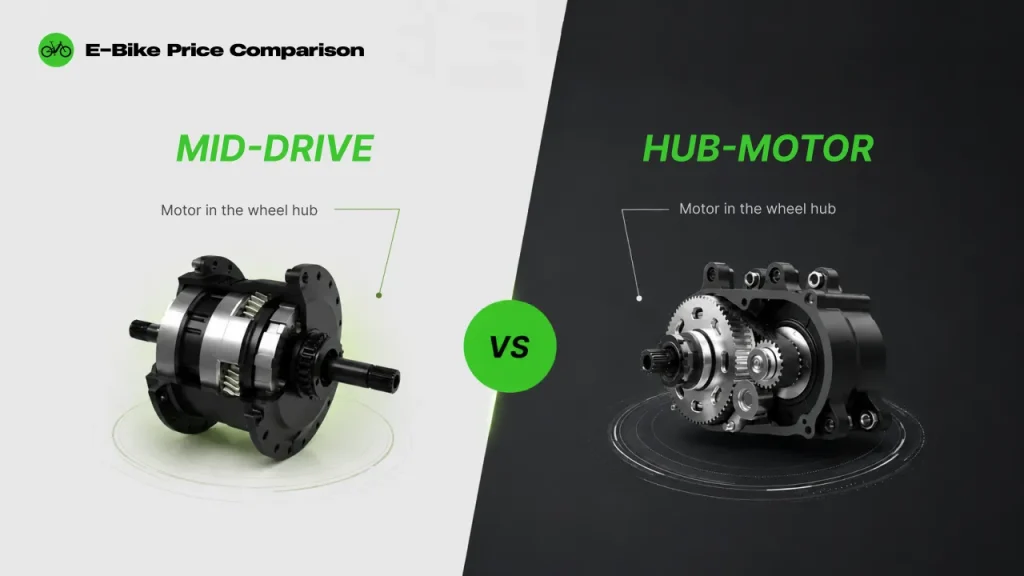
Choosing an e-bike often comes down to one overlooked decision: the type of motor powering it. Retailers rarely explain the difference clearly, and most buyers only discover the trade-offs after months of riding, when a hub motor struggles on a hill it was never designed for, or a mid-drive motor starts wearing through a chain faster than expected.
In this guide, we compare both motor types across performance, maintenance, hill-climbing ability, and real-world costs. Whether you are commuting on flat city roads or tackling steep countryside climbs, understanding this single spec will save you from buying the wrong bike.
How a hub motor works
A hub motor is built directly into the wheel, either the front or the rear. It drives the wheel on its own, independent of the bike’s gears and independent of how hard you are pedalling. Because the motor does not interact with the drivetrain, it delivers power in a simple, consistent way regardless of terrain or gear selection.
Advantages:
- Lower cost, which keeps entry-level e-bikes affordable
- Simple mechanically, so there is less to maintain or go wrong
- Quieter operation, since there is no interaction with the chain
- Works well for flat commuting and general city riding
Disadvantages:
- Less efficient on hills, since it cannot use gearing to multiply torque
- Can overheat on long or steep climbs
- Adds unsprung weight to the wheel, which can affect handling on rough surfaces
- Harder to swap gears or wheels without motor-specific parts
How a mid-drive motor works
A mid-drive motor sits at the bike’s centre, built into the pedal crank. Instead of driving the wheel directly, it powers the bike through the same chain and gears you already pedal through. This means the motor benefits from your gear selection in exactly the same way your legs do. Shift to a lower gear on a climb, and the motor’s effective torque increases along with it.
Advantages:
- Significantly better hill-climbing performance
- More natural, responsive pedalling feel, especially with a torque sensor
- Better weight distribution, since the motor sits low and central rather than in a wheel
- Easier to swap or repair wheels, since the motor is not built into them
Disadvantages:
- Typically more expensive
- Puts additional wear on the chain and cassette, since motor force runs through the drivetrain
- Slightly more complex mechanically
Performance comparison: hills, speed and efficiency

For UK riders dealing with hilly regions such as the Peak District, Yorkshire Dales or Cornwall, this difference is not marginal. A mid-drive motor with sufficient torque handles gradient far more comfortably than a hub motor of similar power. We cover this in more depth in our guide to motors and batteries for steep hills.
Maintenance and long-term cost
Hub motors are mechanically simpler, so day-to-day maintenance is minimal. There is no extra strain on the chain, and the motor itself rarely needs attention beyond basic care. Mid-drive motors place additional load through the drivetrain, meaning the chain and cassette wear faster than on a hub-motor bike. Riders typically need to replace the chain somewhat more often, and gear shifting should be done smoothly, without excessive assist, to avoid extra strain when under motor load.
Over a multi-year ownership period, a mid-drive bike may cost slightly more to maintain, but this is generally outweighed by the better performance and control it offers, particularly for anyone who rides hilly or mixed terrain regularly.
Which one should you choose?
Choose a hub motor if:
- You mainly ride flat or gently rolling routes
- You want the lowest upfront cost
- You prioritise low maintenance over performance
- You are commuting in a city environment
Choose a mid-drive motor if:
- You regularly ride hills or varied terrain
- You want a more natural, responsive pedalling feel
- You are willing to pay more for better long-term performance
- You care about balanced handling, particularly off-road
If you are still deciding, our E-Bike Quiz can match you with a bike suited to your riding style and terrain in under a minute.
Best e-bikes for each motor type
Best mid-drive options:
- ENGWE L20 3.0 Pro — 100Nm torque, folding design, ideal for steep climbs
- HITWAY BK27S — torque-sensor mid-drive for a natural pedalling feel
- VARUN S26 — balanced mid-drive option at a more accessible price
Best hub motor options:
- ENGWE Engine Pro 3.0 Boost — 90Nm hub motor with fat tyres for extra stability
- Suitable for riders who want strong performance without the mid-drive price premium
Browse the full range in our Electric Mountain Bikes and Commuter E-Bikes categories to compare specs side by side.
How we evaluate motor performance
Our comparisons are based on published manufacturer specifications (torque, wattage, voltage), UK EAPC legal requirements, and real-world riding conditions typical of UK terrain, including gradient, average trip distance and rider weight. We update these guides as new models become available, and we link directly to the manufacturer specification pages wherever possible so you can verify the figures yourself.
FAQs
Is a mid-drive motor always better than a hub motor?
Not always. Mid-drive motors are better for hills, natural pedalling feel and long-term performance, but hub motors remain a solid, affordable choice for flat commuting and casual riding.
Do mid-drive motors damage the chain faster?
They increase wear slightly, since motor force passes through the drivetrain. Smooth gear shifting and regular chain maintenance minimise this effect.
Can a hub motor be repaired if it fails?
Hub motors are usually replaced as a full wheel unit rather than repaired individually, since the motor is built into the wheel hub.
Which motor type is legal in the UK?
Both hub and mid-drive motors are legal under UK EAPC rules, provided the motor has a continuous power rating of 250W and assistance cuts off at 25 km/h (15.5 mph).
Do mid-drive motors work with any gear system?
Yes, mid-drive motors use the bike’s existing gears, so they work with standard derailleur or hub-gear systems, though manufacturers usually specify a recommended gear range for best performance.

